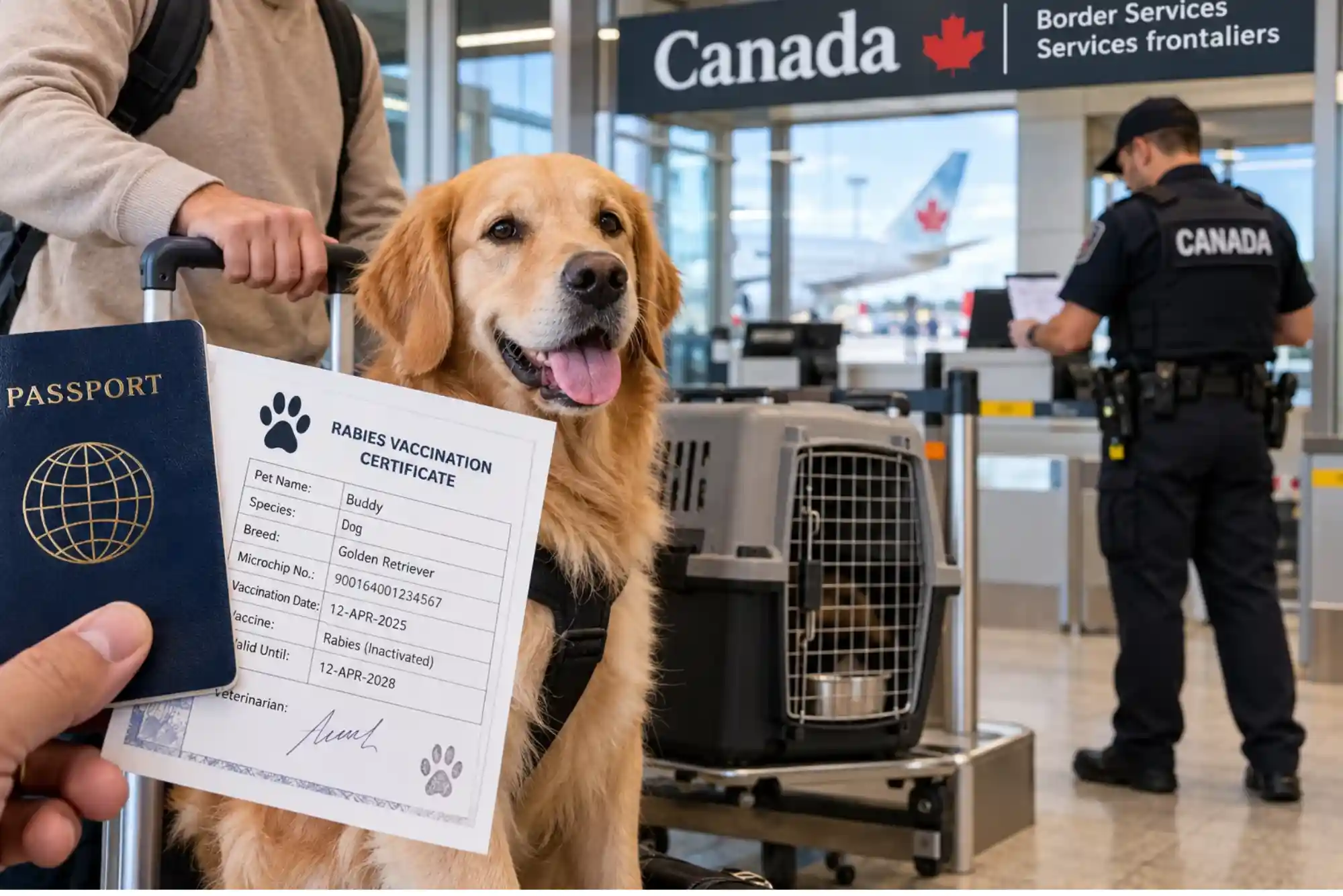
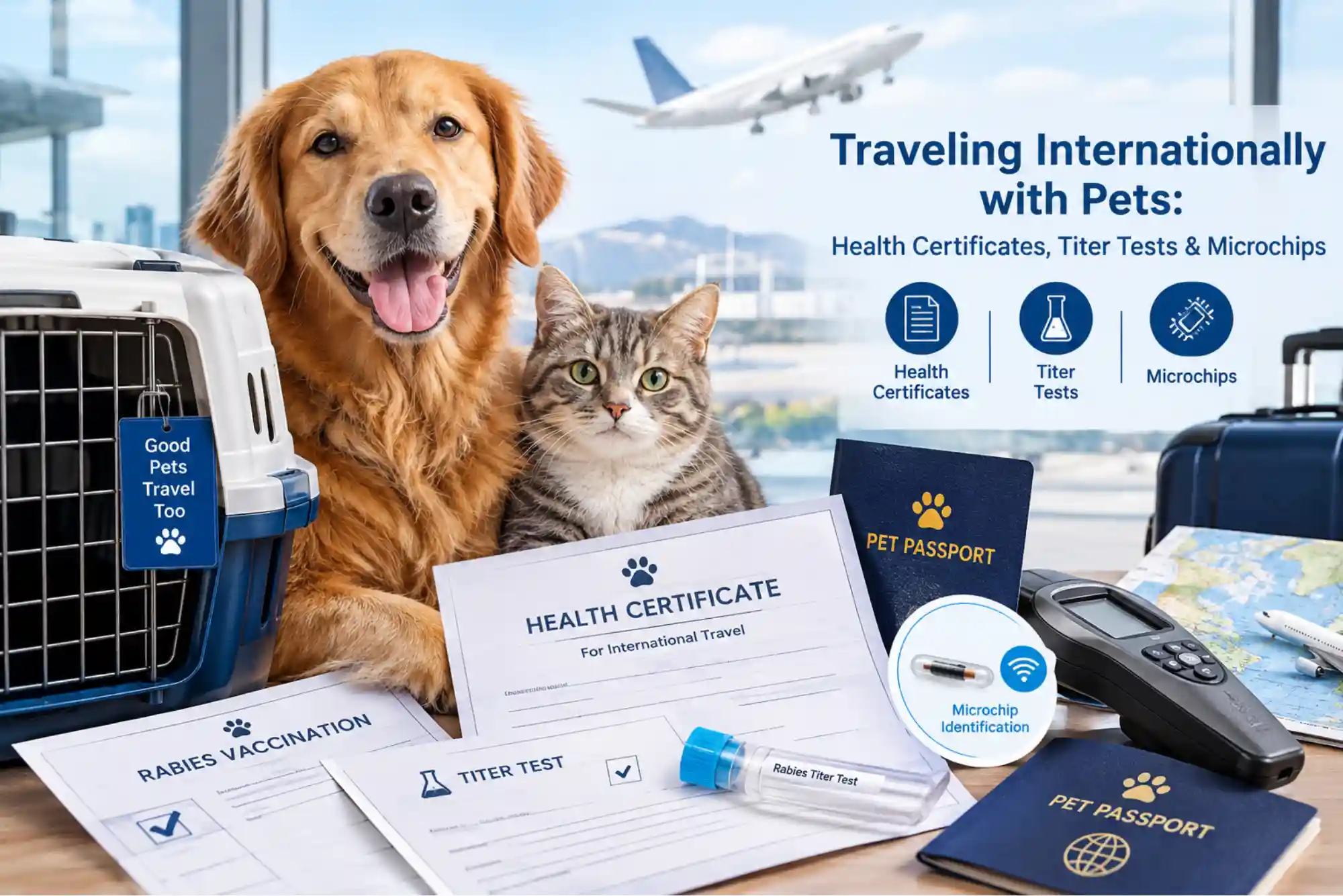
International travel can be an exciting experience, but taking a pet across borders requires considerably more preparation than simply booking a flight and purchasing a suitable carrier. Dogs, cats, and other companion animals may be subject to veterinary examinations, vaccinations, microchip identification, laboratory testing, health certificates, import permits, quarantine rules, and airline requirements.
The exact process depends on the country you are leaving, the country you are entering, the species of your pet, and sometimes the countries through which you transit. There is no single international pet-travel document that works everywhere. Destination countries establish their own entry requirements, and those requirements can change over time. Official guidance therefore recommends checking the rules for the destination before beginning the veterinary process.
For owners planning a complicated international journey, resources such as [International Pet Travel] and [TripMatchup] can also be useful starting points when organizing the different aspects of a pet relocation.
One of the most important things to understand is that international pet travel is a process rather than a single appointment. Some requirements can be completed quickly, while others may require weeks or months of preparation. For example, a rabies vaccination may need to be administered before a blood sample can be taken for a rabies antibody titer test. A microchip may also need to be implanted before certain vaccinations so that the vaccination record can be connected to the correct animal.
According to the USDA Animal and Plant Health Inspection Service, destination countries establish their own requirements, and travelers should contact an appropriate veterinarian as soon as they know they will be traveling.
Understanding the major requirements early can make the process much easier.

Why International Pet Travel Requires Advance Planning
Traveling internationally with a pet involves two separate considerations: the animal’s health and the legal requirements of the destination country.
From a health perspective, the veterinarian needs to make sure the animal is fit for travel and that required vaccinations, treatments, and tests have been completed. From a regulatory perspective, the owner needs to demonstrate that the animal satisfies the destination country’s import rules.
These two areas overlap, but they are not identical.
A pet can be healthy enough to travel but still be unable to enter a country because a required document was completed outside the permitted timeframe. Similarly, an owner may have a valid vaccination record but still need a microchip, laboratory test, import permit, or additional certification.
This is why starting early is important. USDA guidance notes that international pet preparation can take anywhere from a few weeks to many months depending on the destination requirements.
Owners should also remember that airline requirements can be separate from government entry requirements. An airline may have its own rules concerning carriers, documentation, temperatures, booking procedures, or whether an animal can travel in the cabin or as checked or manifested cargo. Meeting the country’s entry requirements does not automatically guarantee that an airline will accept the pet for transportation.
A successful trip therefore requires coordination between the destination country’s authorities, a veterinarian, and the airline.
Understanding the International Pet Health Certificate
One of the most commonly required documents for international pet travel is an international health certificate.
A health certificate is a veterinary document confirming relevant information about the animal and demonstrating that required examinations, vaccinations, treatments, or laboratory tests have been completed. The precise certificate and certification process depend on the destination.
There is no universal health certificate accepted by every country. USDA APHIS specifically explains that each country establishes its own requirements based on the type of animal traveling.
The certificate generally contains identifying information about the pet, such as the animal’s species, breed or description, identification details, vaccination information, and relevant veterinary findings. Depending on the destination, additional statements or supporting laboratory results may also be necessary.
For travelers leaving the United States, some destinations require a health certificate to be issued by a USDA-accredited veterinarian and then endorsed by USDA APHIS. Other destinations have different procedures. The veterinarian and destination-country instructions should therefore be consulted before the appointment.
The timing of the certificate is particularly important. Some countries only accept certificates issued within a specific number of days before arrival. If an owner obtains the certificate too early, it may expire before the pet reaches the destination.
For that reason, owners should not simply schedule a routine veterinary appointment several months before departure and assume the paperwork will remain valid. Instead, they should build a travel timeline around the destination’s official requirements.
The official process can also require supporting documents such as vaccination certificates, laboratory test results, and import permits. Incomplete or inaccurate paperwork can cause delays during certification.
What Is a Rabies Titer Test?
A rabies titer test is a laboratory blood test used to measure the level of antibodies against rabies in an animal’s blood.
Some countries require this test for dogs, cats, or other animals entering from particular countries. It is particularly important for destinations that use rabies-control procedures designed to reduce the risk of introducing the disease.
The test does not replace vaccination. Instead, it is generally performed after an appropriate rabies vaccination when the destination country’s rules require evidence of an adequate antibody response.
The timing is one of the most important parts of the process. Depending on the destination, there may be a required waiting period between vaccination, blood sampling, receipt of laboratory results, and entry into the country.
This means that a pet owner should never assume a titer test can be arranged immediately before departure.
The USDA notes that rabies antibody titer testing is among the laboratory tests commonly associated with international export of pet animals.
The laboratory used may also matter. Certain destination countries require testing through approved or recognized laboratories. A result from an unrelated laboratory may not satisfy the country’s import requirements even if the numerical antibody result appears adequate.
For this reason, the veterinarian should identify the correct testing pathway before the blood sample is collected.
Why the Microchip Matters for International Travel
A microchip is another major component of international pet identification.
A microchip is a small identification device implanted under an animal’s skin. It carries a unique identification number that can be read using an appropriate scanner. The purpose of the microchip is to provide a reliable connection between the animal and its veterinary and travel documentation.
For international travel, microchip timing can be especially important.
Some countries require the pet to be microchipped before certain vaccinations are administered. This helps ensure that the vaccination record can be associated with the correct identified animal.
If a pet receives a qualifying rabies vaccination before the required microchip is recorded, the destination country may not recognize that vaccination for entry purposes. Whether this applies depends entirely on the destination’s rules.
Therefore, owners should confirm the required microchip standard and sequence of events before arranging vaccinations.
The microchip number should also be checked carefully on every document. A single incorrect digit can create an identification problem when documents are reviewed.
Before traveling, it is sensible to have the veterinarian scan the microchip and confirm that the number matches the pet’s records. Owners should also keep copies of important documentation in a secure digital location while carrying the original documents required for travel.
Vaccinations and Preventive Treatments
Vaccinations are another important part of international pet travel.
Rabies vaccination is especially significant because many countries have strict rules concerning rabies prevention. However, other vaccinations or treatments may also be required depending on the animal and destination.
The important point is that vaccination requirements are not identical worldwide. A vaccine that is routine in one country may not satisfy another country’s specific entry conditions.
The destination may specify the minimum age of the animal, the acceptable vaccine, the timing of vaccination, or the period that must pass after vaccination before the animal is allowed to enter.
Some destinations also require parasite treatments within specific timeframes. In certain cases, treatments must be administered by a veterinarian and recorded on the official health certificate.
Because these requirements can be highly specific, owners should avoid relying on general pet-travel advice when planning an actual international journey. The destination country’s current official requirements should be checked for the specific species and route.
USDA APHIS recommends verifying requirements each time you travel because country requirements can change.
The Importance of the Order of Requirements
One of the biggest challenges in international pet travel is that the requirements often have to be completed in a particular order.
For example, an owner may need to have the pet microchipped first, then receive a qualifying rabies vaccination, then wait for the required period, then complete a blood test, and finally obtain a health certificate within a particular period before travel.
The exact sequence differs between destinations, so owners should not copy a timeline from another country and assume it applies to their trip.
The best approach is to create a personalized timeline based on the official requirements.
A veterinarian experienced with international pet travel can help identify the relevant dates. The owner should then work backward from the planned arrival date rather than simply working forward from today’s date.
This is particularly important when a titer test or waiting period is involved. A mistake early in the process can potentially move the entire travel schedule.
Airline Requirements Are Separate From Government Requirements
Even after satisfying the destination country’s regulations, travelers need to check their airline’s policies.
Airlines can establish requirements that are separate from immigration, agriculture, or veterinary authorities. These may include rules concerning the dimensions of the carrier, maximum animal weight, reservation procedures, documentation, temperature restrictions, breed-related policies, or restrictions on certain routes.
USDA APHIS specifically notes that airlines may have additional or different requirements for pets traveling by air.
For this reason, owners should contact the airline directly before purchasing a non-refundable ticket based on the assumption that the pet can travel on the same flight.
The carrier should be appropriate for the animal and should allow adequate ventilation and secure containment. The pet should be accustomed to the carrier before the journey rather than encountering it for the first time at the airport.
Travelers should also confirm whether the pet will travel in the cabin, as checked baggage where permitted, or through a specialized animal transportation service. Policies vary considerably between airlines and routes.
Preparing Your Pet for the Journey
Documents are only one part of successful international pet travel. The animal’s physical and behavioral preparation also matters.
A long journey can involve unfamiliar environments, airport noise, transportation, waiting periods, changes in routine, and exposure to unfamiliar people. Preparing gradually can make the experience more manageable for the pet.
Carrier training is particularly useful. The pet should have opportunities to spend time in the carrier before travel so that the carrier becomes a familiar environment rather than an unexpected source of stress.
Owners should also discuss the journey with their veterinarian, especially if the pet has an existing medical concern or has previously experienced difficulty during transportation.
Medication should never be given simply because another pet owner recommends it. Any decision about medication or sedation should be discussed directly with a veterinarian, because travel conditions and individual animal health can affect whether a particular approach is appropriate.
The goal is to make the trip as safe and predictable as possible.
Documents You Should Keep With Your Pet
International pet travel can involve several documents, and organization is extremely important.
The owner may need the original health certificate, vaccination records, laboratory reports, microchip information, import permits, treatment records, and other destination-specific documents.
Some countries require original documents rather than electronic copies. USDA APHIS notes that where original signed or endorsed paperwork is required, it should accompany the pet during travel.
It is still useful to maintain secure digital copies as backups. Photographing or scanning documents can provide an additional layer of protection if paperwork is lost, although digital copies should not be assumed to replace originals.
The pet’s name, microchip number, owner’s contact details, veterinary information, and travel information should be consistent across all documents.
Before leaving home, review every document carefully. Check names, dates, microchip numbers, vaccination details, signatures, and any required stamps or endorsements.
What Happens If Requirements Are Missing?
A missing requirement can cause significant problems.
Depending on the destination and the missing documentation, the pet may face additional inspections, delays, quarantine, refusal of entry, or other regulatory action. The exact consequences depend on the destination country’s laws.
This is why owners should not wait until arriving at the airport to discover whether the documentation is correct.
USDA APHIS advises that pets must meet the destination country’s import requirements before travel. It also explains that veterinarians and USDA APHIS cannot simply waive another country’s entry requirements.
If an owner believes a requirement may be impossible to meet, the appropriate authority in the destination country should be contacted before travel. Written authorization may be necessary in situations where an exception is legally available.
The safest approach is to resolve uncertainty before the trip rather than attempting to solve it at the border.
International Pet Travel From the United States
For owners traveling from the United States, USDA APHIS provides country-specific pet travel information and explains the process for international export.
Depending on the destination, the process may involve a USDA-accredited veterinarian, an international health certificate, laboratory testing, vaccination records, an import permit, and USDA endorsement.
Some destinations require official endorsement while others do not. The requirements are destination-specific rather than universal.
For example, the current USDA guidance for travel from the United States to Pakistan states that dogs and cats need a health certificate issued by a licensed veterinarian and that USDA endorsement is not required for that certificate.
This example demonstrates why general assumptions can be misleading. A procedure that is mandatory for one destination may not be required for another.
Owners should therefore consult the official destination-specific guidance rather than relying on an international pet-travel checklist created for a different country.
Returning Home With Your Pet
International pet travel planning should also consider the return journey.
Some travelers focus entirely on the requirements for entering their destination and forget that their home country may impose requirements when the pet returns.
This is particularly important when the trip includes countries with different rabies-control classifications or animal disease risks.
Before leaving home, owners should check both the outbound and return requirements. If the return process requires documentation that must be completed before leaving the original country, it should be arranged in advance.
The same principle applies to multi-country trips. A pet traveling through several countries may encounter different requirements at each border, and transit rules can matter even when the animal is not staying in the transit country for an extended period.
USDA APHIS advises travelers going through multiple foreign countries to check the requirements applicable to each country on the route.
Common Mistakes Pet Owners Should Avoid
One common mistake is starting the process too late. International pet requirements can involve waiting periods and laboratory testing, so last-minute preparation may not be possible.
Another mistake is assuming that all countries use the same health certificate. They do not. Destination countries establish their own requirements, and many use country-specific forms.
A further problem is relying exclusively on airline information. Airlines can tell travelers about their transportation policies, but the airline is not necessarily the authority responsible for the destination country’s animal-entry regulations.
Another frequent issue is failing to verify the microchip number. A single incorrect number on a document can create an identification mismatch.
Pet owners should also avoid assuming that a rabies vaccine automatically satisfies every country’s rabies requirements. Some destinations have additional rules involving timing, microchip identification, laboratory testing, or waiting periods.
Finally, travelers should avoid depending on outdated online information. Pet-entry regulations can change, and official authorities recommend checking current requirements for each trip.
How to Build a Reliable International Pet Travel Timeline
A practical timeline begins with the destination country rather than the airline ticket.
First, determine the species-specific entry requirements. Then identify the microchip rules, vaccination requirements, testing requirements, waiting periods, health certificate requirements, import permits, and endorsement procedures that apply.
After understanding the requirements, speak with a veterinarian who can help establish the appropriate medical timeline.
The next stage is coordinating with the airline. Confirm the airline’s pet policy, approved carrier specifications, booking process, and documentation requirements.
As departure approaches, check that all documents remain valid for the actual travel date. Confirm that the health certificate falls within the required validity period and that any required treatment has been completed at the correct time.
Owners should also review the rules again shortly before departure because requirements can change.
Using a dedicated pet-travel resource such as [International Pet Travel] can help owners organize information, while [TripMatchup] can serve as another useful reference when planning the broader journey.
Why Professional Guidance Can Be Valuable
International pet travel regulations can be complicated because veterinary requirements, immigration rules, airline policies, and country-specific procedures may overlap.
A veterinarian experienced in international travel can help interpret the health-related requirements and make sure the animal’s medical records are complete.
For complicated relocations involving several countries, professional pet relocation services may also help coordinate transportation and documentation. However, owners should still verify important requirements through official government sources rather than relying on a third party alone.
Professional assistance is especially valuable when the trip involves multiple pets, unusual species, multiple destinations, connecting flights, or complex laboratory requirements.
Even when professional assistance is used, the owner remains responsible for making sure the planned journey complies with the applicable requirements.
Final Thoughts on Traveling Internationally With Pets
Traveling internationally with a pet is entirely different from taking a short domestic trip. Health certificates, microchips, vaccinations, titer tests, waiting periods, airline policies, and destination-country regulations can all affect whether an animal is permitted to travel and enter another country.
The most important principle is to start early and verify the requirements for the exact destination, species, route, and travel date.
A microchip provides reliable identification, while required vaccinations establish the animal’s preventive-health status. Where required, a rabies titer test provides laboratory evidence of antibody levels. The international health certificate then brings together important veterinary and identification information in the format required by the destination.
None of these steps should be treated as a last-minute formality.
The requirements can differ substantially between countries, and official authorities can update their rules. USDA APHIS recommends checking destination requirements each time an international pet trip is planned.
With careful preparation, accurate records, appropriate veterinary support, and early communication with the airline, owners can reduce avoidable problems and make international travel more organized for themselves and their pets.
Before finalizing a trip, verify the latest requirements directly with the destination country’s competent authority, your veterinarian, and the airline. A well-planned journey begins long before the day of departure.