Whether you’re heading to the lantern-lit streets of Hoi An, the limestone karsts of Ha Long Bay, or the buzzing energy of Ho Chi Minh City, knowing your visa budget upfront saves both money and last-minute stress.
What Is the Official Vietnam E-Visa Price for 2026?
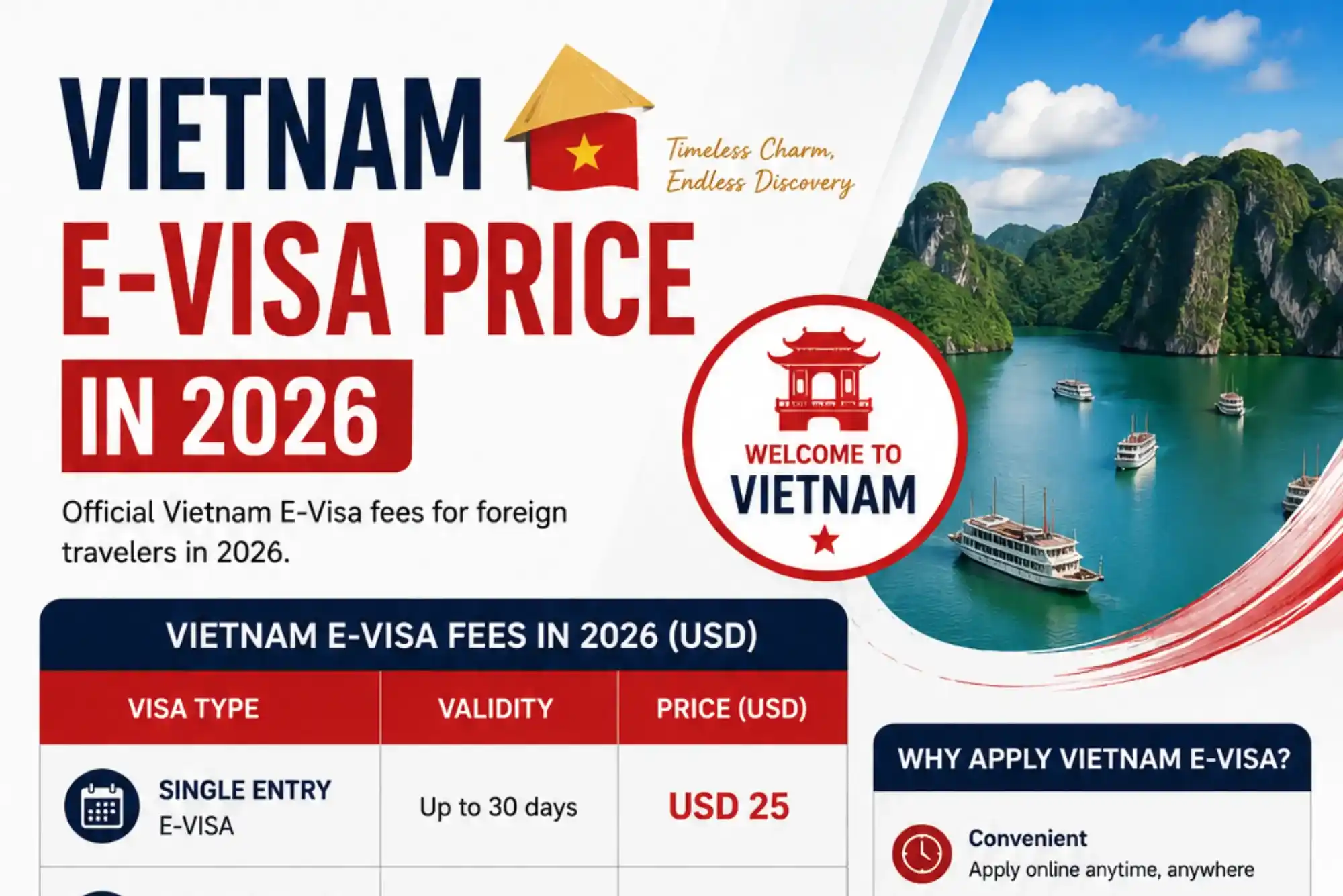
As of 2026, the official government fee for a standard single-entry e-visa to Vietnam remains US $25. This price is set by the Vietnam Immigration Department and applies to citizens of all eligible countries. For travelers needing a multiple-entry e-visa, the official fee is US $50. These prices cover the application processing only—not additional service fees from third-party agents.
It’s important to note that these rates are for the 90-day e-visa, which is the standard option for most tourists and business travelers. Vietnam does not offer a cheaper 30-day e-visa anymore; the unified 90-day e-visa replaced older options in late 2023.
Detailed Fee Breakdown for 2026
Below is a clear pricing table showing exactly what you can expect to pay to the Vietnamese government, depending on your visa type.
| Visa Type | Official Fee (USD) | Processing Time | Validity Period |
|---|---|---|---|
| Single Entry (90-day) | $25 | 3–5 working days | 90 days from issue date |
| Multiple Entry (90-day) | $50 | 3–5 working days | 90 days from issue date |
| Emergency/Express (via agent) | $50–$100+ | 2–24 hours | Same as above |
| Government portal service fee | $0 (free to apply directly) | — | — |
Pro tip: The government processing time is officially “3–5 working days,” but many travelers report receiving theirs in 2–3 days. Never book non-refundable flights or hotels before your visa is approved.

Single Entry vs Multiple Entry: Which One Saves You Money?
Choosing between single and multiple entry depends entirely on your itinerary. Let’s break it down with real scenarios.
When to choose a single entry e-visa ($25)
This fits 90% of short-term tourists. You fly into Hanoi, travel south to Ho Chi Minh City, and exit the country without re-entering. Also ideal for travelers staying in Vietnam continuously for up to 90 days.
Common Mistakes That Inflate Your Vietnam E-Visa Price
Over the past few years, experienced travelers have noticed a few recurring pitfalls that turn a $25 visa into a $100 headache. Avoid these at all costs.
Using unofficial “fast track” services at the airport. Some arrivals counters sell express processing for $30–50. This is unnecessary if your e-visa is already approved before landing.
Applying too late. Rush fees through third-party agents can cost up to $100 for same-day processing. Always apply at least two weeks before your departure.
Wrong port of entry on the application. If you list “Noi Bai Airport” (Hanoi) but actually land in “Tan Son Nhat” (Saigon), immigration may deny entry. You’d then need a new visa – paying again.
For specific destination planning, it helps to understand local travel costs beyond just the visa. Our detailed Malaysia payment and cashless guide offers useful comparisons for travelers combining both countries.
How to Pay the Vietnam E-Visa Fee Safely
The official e-visa portal accepts payment only via credit or debit cards (Visa, MasterCard, American Express). Some international cards may trigger bank fraud alerts, so notify your bank before applying.
Unlike many other countries, Vietnam does not offer PayPal, bank transfer, or cash payments for e-visas. Never send money to an individual’s bank account or via Western Union for a visa—that’s a common scam.
Once you pay, you receive a confirmation code. Keep this safe. You’ll need it to check your application status and download the final e-visa PDF.
Refund and Rejection Policy – What If You Pay and Get Denied?
This is where many travelers get frustrated. The Vietnam e-visa fee is non-refundable—even if your application is rejected. Common rejection reasons include:
- Blurry or incorrect passport photo
- Passport validity under 6 months
- Criminal record or previous visa violations (rare but possible)
- Typographical errors in name or passport number
There is no appeal process. You simply reapply and pay again. That’s why many nervous first-timers prefer a visa agent who reviews the application before submission. The extra $10–20 can be cheaper than paying twice.
If you’re also planning hikes during your trip, you might appreciate this practical trail guide for hiking near Da Nang, which includes route distances and local tips.
2026 Price Comparison: E-Visa vs Visa on Arrival vs Embassy Visa
Vietnam offers three main visa channels. Here’s how they compare on price and convenience.
E-Visa ($25–50): Fully online. Best for 90% of travelers. No stamping fee.
Visa on Arrival ($15–25 + stamping fee): Requires approval letter ($15–25 from an agent) plus $25 stamping cash at airport. Total often $40–50. Less convenient than e-visa.
Embassy Visa ($60–100+): Visit a Vietnamese embassy in person. Expensive and slow. Only needed for special cases.
Visa on arrival used to be cheaper, but since the e-visa was extended to 90 days, most travelers prefer the simpler e-visa process.
Does the Vietnam E-Visa Price Change by Nationality?
No. Unlike some countries (looking at you, e-visa for India or eVisa for Turkey), Vietnam charges the same flat fee for all eligible nationalities. Citizens from the US, UK, Australia, Canada, Germany, France, Japan, South Korea, and others all pay $25 single / $50 multiple.
As of 2026, citizens from 80+ countries qualify. Always check the official list before applying—it rarely shrinks, but it’s wise to confirm.
For a broader understanding of travel costs across different destinations, you might also find our Malaysia duty-free shopping guide helpful for comparison shopping across borders.
Step-by-Step: How to Avoid Overpaying for Your 2026 Vietnam E-Visa
Follow this quick checklist to pay exactly the official price—not a cent more.
- Go directly to the official Vietnam Immigration website (look for .gov.vn).
- Fill out all fields exactly as on your passport.
- Upload a passport-style photo (white background, no glasses).
- Select single entry ($25) or multiple entry ($50).
- Pay by credit card. You’ll see the exact fee before clicking “pay.”
- Wait 3–5 working days.
- Download your PDF e-visa. Print two copies.
That’s it. No hidden fees. No “processing charges.” No mandatory insurance add-ons.
Final Verdict: Is the Vietnam E-Visa Worth It in 2026?
Absolutely. For $25, you get a 90-day single entry visa without visiting an embassy or mailing your passport. It’s one of the most affordable and traveler-friendly e-visa systems in Southeast Asia.
Just remember the golden rule: apply early, double-check every field, and always use the official portal unless you need express or concierge support. The official Vietnam e-visa price in 2026 remains a bargain compared to regional neighbors like Cambodia ($35+) or Myanmar ($50+).
Whether you’re backpacking for two months or on a two-week photography tour, the e-visa fee is likely the smallest part of your budget—but getting it wrong can cost you time, money, and peace of mind. Plan ahead, pay the correct fee, and enjoy one of Asia’s most rewarding destinations.
Related Reading: Qatar Visa Price in 2026: Complete Cost Guide, Updated Fees and Travel Insights
Related Reading: Turkish Visa for Iraqi Price in 2026: Updated Fees and Price Breakdown